Friday, February 7, 2014

What a story he could tell...

We acquired this animal about 20 odd years ago.  He is a success story from the Sweetwater rattlesnake roundup.   Possibly the only animal to survive that awful experience.  His story is unique.


We had just opened our reptile exhibit and a guy came by with a rather nice wooden box that he said he transported snakes in.  He had a diamondback that he brought back from Sweetwater, thinking he wanted to keep it himself, and then second thoughts.  He wanted to know if we were interested in the animal. Of course we said yes. 


Now this guy was not the average spectator.  He had an "official' red vest and patches galore from all the roundups he had participated in.  He was more than proud of that fact, and it was all we could do to be civil and "visit" with him until he left.


The animal was thin, as to be expected, and not all that big, probably a couple feet.  But he didn't show any outward signs of noosing, manhandling, etc which could have been present.  All we could do was set him up, and hope for the best.


Fast forward those 20 odd years and here is his picture!

 
Yes, it's a close up, but he doesn't look underfed,does he?


We've moved since then, changed our business name, etc, but we still have the snake.  He's "happy", healthy and a great display specimen.  He's well over 5 feet. He virtually never strikes when people tease (and we haven't gotten to them first) and he rattles almost on command.  

Monday, February 3, 2014

Texas Rattlesnake Festival

I wrote about this in an earlier post, but here's a nice "poster" describing the event.  There will also be vendors selling goodies, such as Neodesha cages, the BEST venomous cages!

 
So come on down!  What else do you have to do that weekend?  Might be a nice change of pace from the nasty weather that's been plaguing us this year.
 

Sunday, February 2, 2014

Here's your sign!

After retiring, I decided that I needed more signage around my place, to attract business to the Serpentarium, since I was finally in a position to work with my favorite animals, full time.  This is one of the signs. 
Think it draws attention?  I also had another made, for my other passion...
 And this is how it looks, mounted on the fence.  The "open" sign goes up and comes down, dependent upon the weather, etc.  As people may know, this has NOT been a herp-friendly winter!

For the really observant, notice the t-shirt I'm wearing is the same one as Jim Harrison is wearing in a recent video on Facebook, of him milking a timber rattler.  (He had just been through hip replacement surgery.)  Obviously we run around in the very same, elite (?) circles! 

Tuesday, January 14, 2014

Texas Rattlesnake Festival

And awaaaaaaaaaaaay we go!!!!!!!!!!!!!!  Ya'll come down!!!

Have you heard the news???!!!

Finally, there's gonna be a "rattlesnake festival" for the family, AND the rattlesnakes, to enjoy.  This is an EDUCATIONAL event, a REALLY educational event, not a blood-letting with total misinformation, and the needless destruction of hundreds, or even thousands of hapless animals. who were probably NOT collected legally, locally, logically, etc. 
 
Even if you're not a snake-lover (and who isn't???) this is your chance to be well-informed on the positive side of snakes and their place in nature and our lives.
 
Lets drop the word "round-up" from our vocabulary once and for all!!!

Saturday, January 11, 2014

Blast fom the past...


Since the weather has been absolutely miserable, I've been cleaning out drawers, etc, and came across some old, OLD price lists.  This is not the oldest, but one of the more interesting for a variety of reasons.    In its "hey day" the Philadelphia Reptile Exchange was owned and operated by Hank Molt (name ring a bell to some of you?)!  He was one of the more infamous reptile dealers at the time. 
If you look at some of the prices, you almost wish you could go back to those days, but then again, your income was probably much less than it is today.  Captive breeding was in its infancy, so all those were probably imports and mortality could be very high. 


Many of these animals are not even available to the general public any more.  Prices have risen and fallen.  Color morphs were not anything people worried about, with the exception of yellow Eyelash Vipers (B. schlegeli.)  At that time the majority that arrived in the U.S. were green, (even though the price list has "yellow" indicated as being available) and we were happy with those!  Some of the scientific names have changed.  But remember, this was over 40 years ago. 

Guess that makes me one of the "old timers!"  But then I've been collecting price lists practically since my "infancy!"  Enjoy the read!


Wednesday, January 1, 2014

Translation Guide

I was cleaning out some of my files today (trying to turn over a new leaf for the New Year.  (Don't have to keep everything! I came across this list.  The "Translation Guide for Herp Price Lists."  Don't know where it came from originally, so I'm sorry for not giving credit, where credit is due.  Whether you get a price list through the mail (does anyone send them out any more?) on the internet, or even get this information in person, at a show, from the seller, a lot of it rings true.  

What the seller REALLY means:

butter yellow, lemon yellow, high yellow phase :   tan
cranberry red or bright orange phase :   brown
jet black or snow white :   gray
possible het :   everything is possibly het
albinistic :   has one scale that is lighter than the rest
hyper-hypo-amel-xanthic-anerythristic :   looks slightly different from normal
possibly gravid :   a male was kept two cages away
breeding pair : there are two animals
best we have ever seen :   since last week
so nice we almost kept them ourselves :   we have no idea how to breed them
we were the first to breed them :   we imported the first hatchlings
this species is hard to obtain :   until next month
we have CITES paperwork :   just don't expect a copy
zoo bred :   but you can't know what zoo
well started hatchlings available :   the eggs were just laid
large juveniles available :   the eggs just pipped
subadults available :   anything not large enough to breed is a subadult
pick of the litter :   the first one they pick up
hand-picked :   someone's hand touched them at some time or another
well-established import :    one week in the U.S.
long-term captive :   two weeks in the U.S.
very hardy species :   they take at least a month to drop dead
inquire about price :   they want to see what someone will offer them
dog tame :   only bites if you try to touch it
aggressive feeder :   flicked its tongue at a mouse
deparisitized : a jar of flagyl was waved in front of the cage
farm-raised :   think of the world as a giant farm
extra nice or immaculate :   has all its body parts
slight scar :   missing an eye
imperfect :   missing a limb or tail
large scar :   missing its head
proven breeder :   actually referring to the adults that produced the animal
sale-sale-sale :    no one wants these, and they're dying on us
investment quality :   please buy these so the dealer has some money to invest in something else
chance of a lifetime : buy these and have a possible lifetime of trouble with the authorities

And always remember to multiply any listed lengths by 2/3 and listed weights by 1/2.  EXAMPLE:  a 15 ft. 100 lb. Burmese Python is really 10 ft. and 50 lbs. 

As for the last comment, for many people, when describing an animal they saw some place (especially in the wild), the opposite rings true.   A 3 foot snake becomes a 6 footer, and was as big around as your bicep, (rather than your thumb!)


Tuesday, December 10, 2013

Field collecting absolutely everything???

Some of you may never have field collected.  Some of you may only field collect.  Some of you are doing this for new bloodlines.  Some of you are doing this to increase the variety of your collection.  BUT, some of you are doing it to increase the number of dollars in your wallet.

This post is directed towards those who are collecting every living animal just to make a dollar.  Perhaps your excuse is that you're just trying to recoup the cost of your trip.  But when you take animals that have little or no chance of survival outside their respective niche, then that is totally irresponsible, and you may be contributing to the loss of a species.

This rant comes from seeing some Horned Lizards being exhibited for sale at a recent reptile show that we attended.  Most people know that Horned Lizards (horny toads to most people) almost exclusively eat ants.  So...new owner...did the seller tell you that?  Do you know where to get ants?  And how many ants does it need to keep weight on and thrive? 

If you see this at a show, perhaps you should tell the show sponsor that this is not appropriate.  But the damage has already been done when the animal is removed from its habitat.  The person who took it is not going to drive back to return it.  They're probably not going to try to find those ants for its diet either.  They'll just try some other insects and let it languish and die while in their "care" if they can't find someone to buy it.

So, field collect if you want, but with integrity.


Crocs in winter...

See anything?  Nope, and they're NOT hiding under the snow!

We just got about 10 inches of snow.  Of course the crocodile which inhabits the larger enclosure has been shut inside since the middle of October.  The alligators, which inhabit the two smaller enclosures have been in since about the first of November. 

We would never leave these animals out year round, even when snow is not in the forecast.  Being in a latitude that does have variable weather, we have made accommodations for them inside a heated building.

This being said, we recently heard that there were some people in more temperate climates (think Arizona or Southern California for example) who are worried about their animals being outside since they too are experiencing a cold snap.  I can only say if it were me, I'd be bringing them inside, regardless of where they needed to be housed (e.g. tortoises in the bathtub?)  Even if they were all in cardboard boxes, at least they would be in a controlled environment. 

The time to worry about these things is not when it happens, but when you take ownership of the animal(s).  If you keep them inside, for the (usually) short duration of the inclement weather, your house may develop an "odor", but again, a cheap air freshener is still better than trying to replace your reptilian pals. If you elect to build heated enclosures outside, perhaps your electric bill would go up, but that would probably be far less than the replacement cost of your collection.

It's just common sense.

Friday, October 25, 2013

5,000 ball pythons later...

 
Finally got back to the huge (and I do mean huge) reptile show in Hamburg, PA, that’s held a few times a year, but we prefer the October show. They are the biggest/oldest show to showcase venomous snakes, and that was the main attraction, for us anyway.
 
The venomous contingency has been getting smaller and smaller. Many reasons probably account for this, including Pennsylvania coming down a bit harder on laws protecting some of the species; older/experienced adults are getting out of it, as they (we?) retire, have children or grandchildren; or heaven forbid, lose interest?
 
This year was a bit of a surprise, and a disappointment as many of the vendors we expected to see just weren’t there. Perhaps they were at other shows? There does seem to be a growing trend of larger shows all across the US, with lots of name recognition (NARBC for example) that, we assume, draw bigger crowds with their profusion of advertising, corporate sponsorship, etc, etc.  Although to clarify, NARBC does not allow venomous.
 
That being said, the other interesting factor we looked forward to at the Hamburg show, was the absolute variety of animals you could see in person as opposed to reading about on a price list, and ordering but with just faith in your fellow herper. ( We’ve all read the horror stories of the disgruntled buyer and/or the far less than honest seller.) Only this time it was all ball pythons…an absolute minimum of 5000! Just a few (maybe even as few as a couple) years ago it was corn snakes/leopard geckoes/bearded dragons. Now a sea of ball pythons.
 
Okay, I’m not knocking them. They’re wonderful, small pythons. The variety of color and patterns amazing. The prices too, can be amazing. Especially for some that appear to be colored quite normal, but they may have “XYZ” genes, so “If you breed them to…”, well, you get the picture.
 
We didn't leave empty handed.  There were some animals we couldn't pass up!  But we did not bring home any ball pythons...
 

Friday, October 11, 2013

Love knows no seasons...

Found these two on the pavement of the parking lot at the Nature Center, oblivious to cars, and almost everything else going on around them.  Mind you, it's October 10th.
Didn't most of us think that reptiles mated in the spring?  Maybe this was purely recreational?  The female doesn't seem all that interested.  Or perhaps she's just embarrassed to be exposed like this in the parking lot, and not a more intimate surrounding!
 
Notice the wet spot near the animals.  I'm not an amorous turtle expert but I do wonder if the male did that to mark his territory as if to say to any other male turtles in the area "Stay away, she's all mine."  Or perhaps the female was leaving her own mark with a "Come hither" attitude? 
 
I gently removed them to a leafy hillside close by so they could resume their activities.  


Hybrid, Cross-bred, why bred or rye bread?

I am so confused as to why people do certain things with reptiles, such as cross-breeding animals that would probably never meet in the wild, let along breed.  I'm assuming it's to get different color morphs, but then the animal is not a "pure" anything!  Kinda like "designer dogs" which are just mutt puppies.  Except this is much more common among mammals than reptiles, and mostly due to inattendant pet owners. 

I'm not going to mention the particular cross-bred animals I came across on the internet today, because I don't want to ruffle any feathers, or should I say scales?  I was at a reptile show a couple weeks ago, and I also saw some cross-breds there.  They were (---x---)  and the prices are rather high for essentially "mutts!" I don't want to narrow down the particular species which may identify the person who did this.

To clarify, these are NOT hybrids.  According to Webster's, you would have to cross two genetically dissimilar animals.  Think cornsnakes and kingsnakes.  And yes, this has been done. 

There was talk a few years back that all the different forms albino milksnakes available were from crossing various milksnakes with one or two albinos, even though they might not have been the same species. (Think sinaloe crossed on thayeri, just for an example.  Don't know if it was ever done.)  There is talk that some of the odd, grey cornsnakes (are they called "black"?) are from crossing Great Plaines Ratsnakes on common cornsnakes, to get that black gene and dilute the red. 

The downside of the cornsnake brouhaha, is that true "Okeetee" corns are far and few between, and unless you caught one in North Carolina, at the Okeetee Hunt Club, chances are you just have a red cornsnake with no particular locality to call home.

I'm a purist.  I prefer to know the background of my animals.  But then I'm not looking for the next designer boa to make my fortune.  I just want the best animals I can afford. 

Let's get kinky!

Gotcha!

So, the other day, there was a picture on Facebook of a snake, and of course the person who posted the pic was all upset as to what type of snake, etc, etc.  The majority of responses (or so it would seem) were from people who said anything from a cottonmouth, to a black rat snake, and of course "the only good snake is a dead snake." There was a very obvious answer as to the type of snake being pictured.  That being the way the snake "kinked up" when viewed.

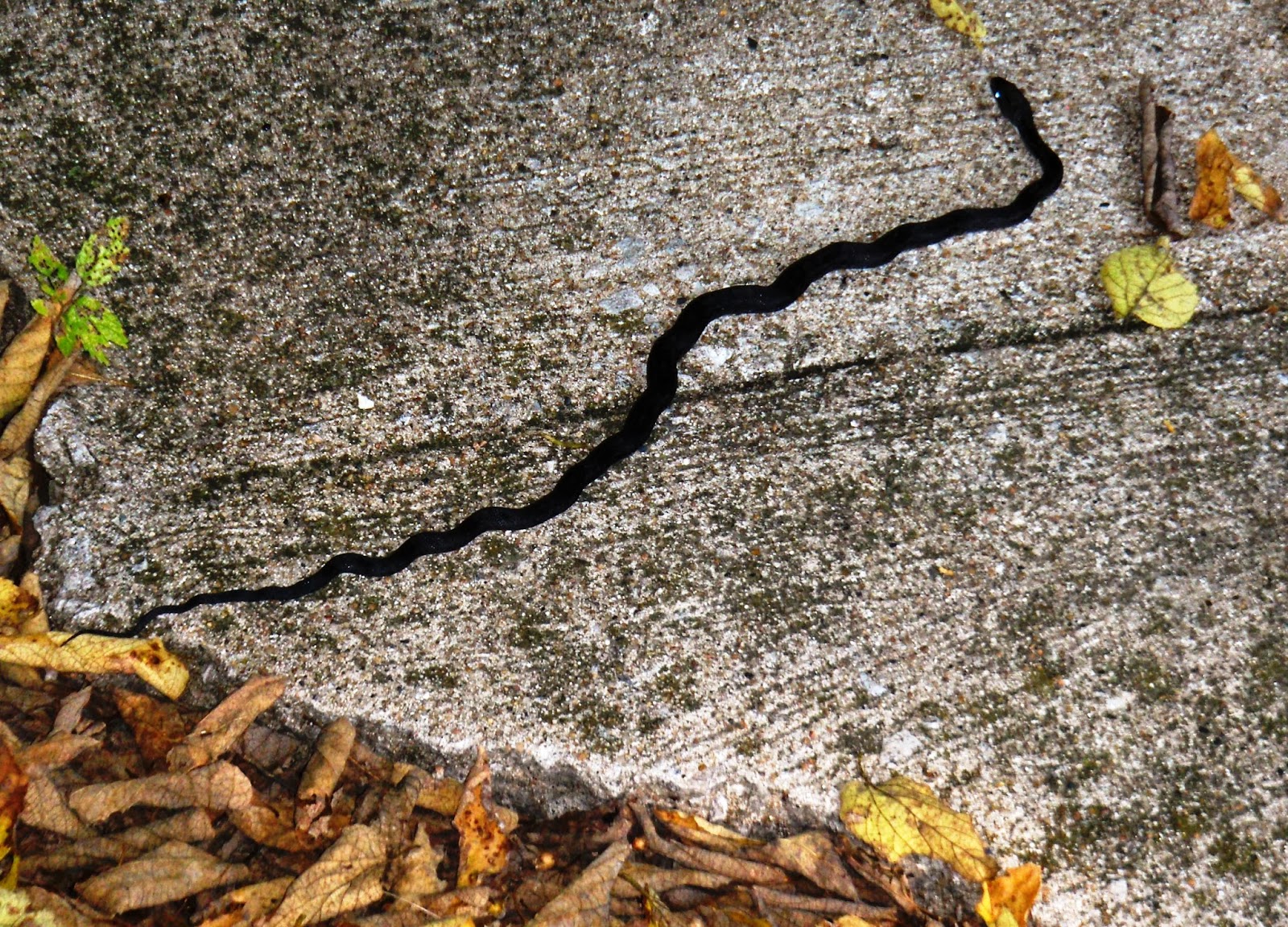
Today, after coming home from a trip to town, we found this guy on our sidewalk, next to our well house.

A bit kinky, wouldn't you say?  A very typical attitude for a black rat snake that knows something is going on.    Here's another shot as it was trying to get away, back to the hole it came from.
The most interesting feature, to us anyway, was that this snake was less than 2 feet long and almost solid black already.  Many black rat snakes, in this area, keep their pattern until they're upward of 3-4 feet or more.  This little guy should be a beauty in adulthood.
 
As for the "kinking", perhaps they want more "spring" in their step when they try to get away from their perceived threat? 
 

Sunday, August 18, 2013

Elaine was bitten by a copperhead!

Oh, Elaine is our corgi, dog that is... 

Not the first time we've had a dog get bitten by something venomous, and we assume it was a copperhead since that's the only venomous snake in our neck of the woods.  We were mowing one of the pastures, and our dog usually follows us around looking for small mammals (especially rats or mice) that get run out of their hidey holes by the mower.

When we were through. about 2 p.m., we noticed she was walking unsteadily from under the front deck of the house.  Then we saw her swollen head, which she had trouble holding up, and her eyes were mostly shut. 
You can see a faint tinge of blood too, but that probably came from the two rabbits she had killed previous to the snake bite. 

We decided, from previous experience with another dog, to just monitor her progress, and make sure her airways were open.  Sine most animals get bit on the head, that is the most likely cause of distress...not being able to breathe due to swollen closed air passages.  By 6:00 that evening she looked better.  But her face is still obviously swollen.

 
Today she looks even better, and was running around barking, and contemplating chasing the horses.  She has edema under her chin, and may have draining later, but she's almost back to normal.

So what should someone expect if their dog gets bit?  It would depend on the size of the dog, and the type of bite received.  Copperheads are not know for "bad" bites, and the fact that animals do not react as frantically as humans do, I believe, aids in their recovery.  Of course you need to monitor the animal's behavior closely after the bite, but in this case all's well that ends well.
 

Saturday, August 3, 2013

Brothers born miles apart or...

We recently acquired these two Prairie Rattlesnakes, from areas that were 50 miles apart,  So what should we think?  Are they the same animal genetically?  Are they two different species or subspecies?  Are they sexually dimorphic?  (We haven't probed them yet to determine sex.)  Maybe they're intergrades?  But with what?  You can almost take yourself back to Darwin's' time and wonder how he might have classified these two, given the circumstances. 

We're not color-driven herpers (thinking  $$$) looking for the next unusual morph.  We just like what we see, but in this case we're not sure what we're seeing.


These pictures were taken about 10 minutes apart, same enclosure, same exposure to light, and flash, and editing.  So, what do we have here???
 

Monday, June 24, 2013

What's in YOUR back yard???

We are blessed to live in the country, in a relatively unspoiled area (not many homes, lots of open spaces, woods, pasture, etc, etc.)  And we keep finding herps in our yard, that we did NOT release, and that really should not even be there.  When I say they shouldn't be there, I mean because they're a mile or more from their "preferred habitat!"  So here's our latest "find" in the back yard, literally, the BACK yard!


Shouldn't everyone have one?

Not the biggest snapping turtle we've ever encountered in the "wild" but definitely the stinkiest!  I tried to show his/her musk glands which are located behind the front legs, on the side.  These shots were taken a day later, but the day of the "capture" this turtle was just oozing musk.  OMG, such a stinky animal! Great defense!

In a previous post I mentioned we found a very large slider in our front yard.  And in that post I also mentioned that we are at least a mile from the river.  We do have some "drainage" behind the house, but it drains towards, the river and most of the time is dry and overgrown with grass.  Obviously these animals can travel quite a ways, under less than optimal conditions, for whatever reasons we can only surmise. 

Monday, December 31, 2012

Hey, what's in that hay???


As you can see from the picture, we got a bit of snow this LAST DAY of December!   You can also see we have horses, and of course we were getting low on hay, so we had to go to the local feed store and buy some.  We hooked up the jeep and headed on out to pick up a few bales to last us though to the weekend


The hay is kept in an outside shed at the feed store.  We pulled through the shed and waited for one of the guys to help load it.  He jumped up on the stack, and jumped back as he said "Would you look at that!  A snake!"  I said "Let me see" and pronounced it as a Prairie Kingsnake, and that I was going to take it home.  Needless to say it was very, very cold, but still able to move a bit.   Glad we were there to find it, as if it were any one else, they probably would have killed it thinking it was a copperhead, as every "brown" snake around here must be a copperhead!  It's a bit warmer now, at home, and we'll be letting it go when the warm weather comes back.  We may rehibernate it in the meantime.  We have enough mouths to feed over the winter now!  But this is still one lucky kingsnake!


Monday, November 26, 2012

He ddn't get to vote, but he doesn't care...

I (Maryann) worked a polling station this past Tuesday (presidential election 2012), and had an hour for lunch.  Since I only live about 6 miles from the polling station (and in the country that's about a 10 minute drive) I decided to come home.  Found this guy stretched out on the pavement, near the creek, apparently getting some warmth.  Some guys stopped to ask me if it was a cottonmouth.  I replied that I certainly would not be holding it as I was, if it were venomous.  The snake complied by holding his mouth open, as pissed watersnakes will do, and showed them his mouth was indeed not white.  Mind you, this is November 6th, and the temperature in my car said 55 degrees. 


We're holding him until Friday, when the temps are supposed to be in the 70s, and then let him go.   It's always interesting to see herps out so "late" as, in times past, we've had snow at this time of the year.  

I also volunteer ar the local "Nature Center" and last weekend we had reports of a snake (the description fit that of a juvenile Black Ratsnake), box turtles, and water turtles out and about.

Can you say "global warming?"

                                                      *********************************


UPDATE:  We are keeping him over the winter probably.  After we cleaned him up, we noticed he had a gaping wound down his tail.  He has movement, but it looks very bad.  Therefore, we thought he'd be better off being rehabbed here rather than thrown out to fend for himself. 

Thursday, November 1, 2012

Do a good deed!

It's been a while since we've gone to a reptile show that had "hots."  We couldn't go to Hamburg this fall due to a catastrophic illness, but all is well now.  Since we still needed "to get out of town" for some R&R, we went to the Repticon show in Dallas.  But this is not about the show.

We did find one table devoted to stopping rattlesnake roundups!   I was glad to see these folks taking initiative as we can't be vocal enough in telling everyone who will listen, that round-ups are an abomination. They had literature, a person giving regular presentations on the problems and horrors involved in these round-ups, and...a way to make money to support their cause...t-shirts!

 
Not that I don't already have enough herp-related t-shirts, but this is different!   These shirts make a definite statement and need to be seen! And not just by fellow herpers.

 
The shirt says "Education, not eradication."  The way it's folded, that's not so obvious.  Lotsa colors, lotsa sizes, lotsa reasons to own this shirt!  I'm embarassed that I don't remember the names of the gentlemen involved in this endeavor.    But at least someone is involved, in a more-than-casual way!
 
PETA isn't doing anything; HSUS wants money before they tackle ANY animal abuse, etc, etc., and even then it goes mostly for administration, and little towards actual animal rescue. 
 
 Here's one way you can get a shirt, in case you don't find these guys at one of your shows.  The web site is: WWW.Newtstees.com 


Special delivery!

You may know (should know) by now that we are crocodilian happy!  We love 'em!  So when our Morelet's passed away earlier this year, we were devastated.  At the time we knew them to be unavailable to the average collector.  Recently they were taken off Appendix 1, and our friend, Bob Clark, imported a group that were "farm-raised."  Of course we were on the phone ASAP and ordered one (or 2 or 3...)

 
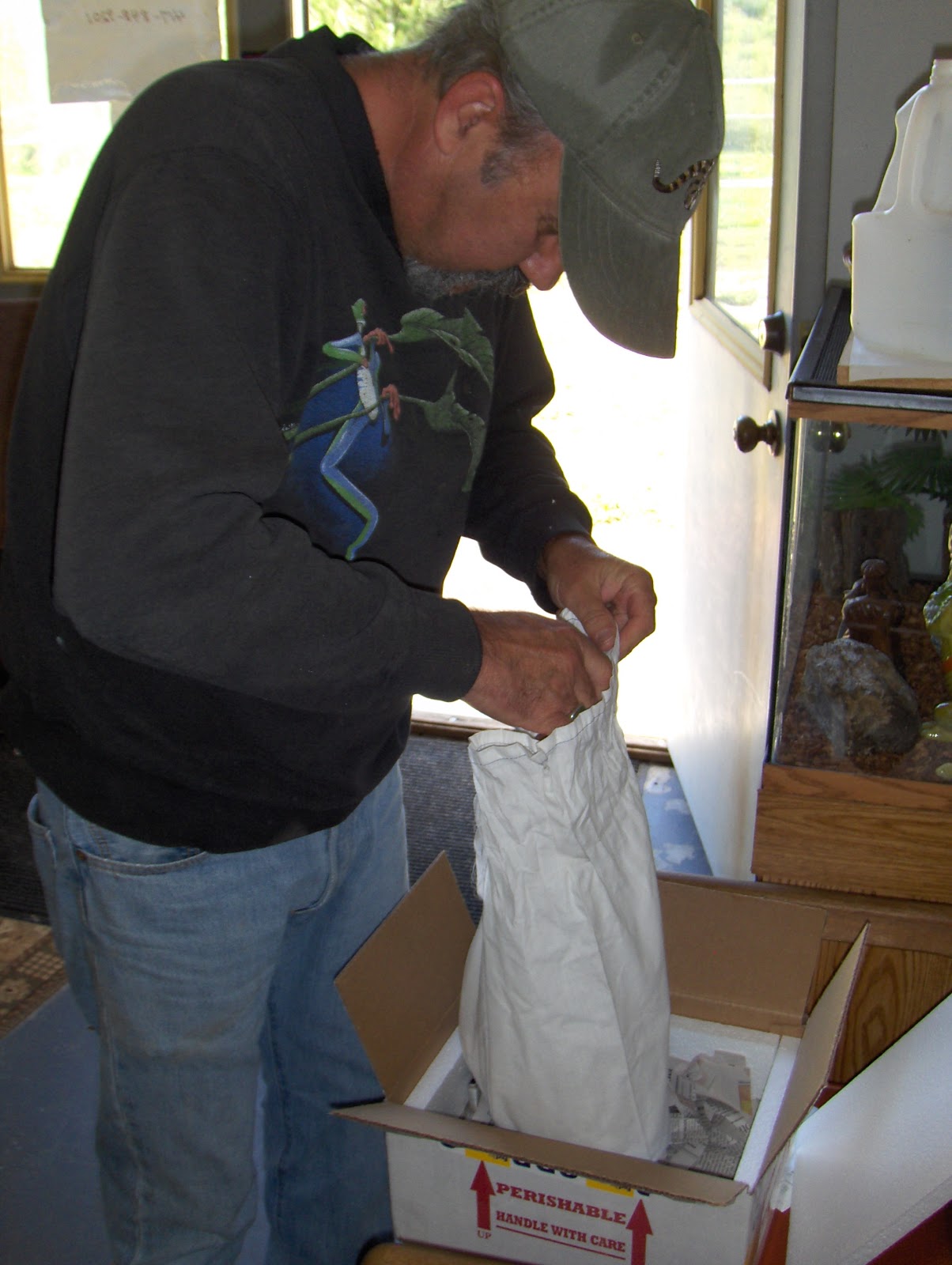
They came on a Saturday (God love you Fed Ex!)  We told the driver what they were but he didn't stick around to see for himself.  Probably on a tight schedule, but it does give him something to tell his friends and co-workers about!  Then we slowly opened the package...

 
Well packed, in a bag of shredded newspaper, inside the styrofoam box, inside the Fed Ex box.  The way we should all send out animals!  Safe, sound and protected.  And voila...
 
 
Cute?  We think so.  They were a bit shy at first, when we tried to feed them, but they are now quite voracious.  We have them all in separate tubs, eating newborn pinkies.  They are growing and thriving.  Why three?  Well, we wanted to guard against any unforeseen mortality!  It should take them a while to get to the size where we have to build those rediculous large enclosures, but we're happy to wait!


Tuesday, August 21, 2012

"Come on in," I said!

"Don't mind if I do,"  said the copperhead at my doorstep!

NO, this is not how the scenario went, but it could have.  I came home from work, walked in to the house to unwind, get something to drink, perhaps a small snack, and then go back out to the shop to take care of the animals (herps.) 

I opened the door, and the dog went out first.  For some reason I looked down, and there was a copperhead.  Not just in my way, but at the very edge of the doorstep.  Now was it there when I went into the house?  Did it crawl over in the short time I was in the house (less than 10 minutes?)   I debated on what to do, decided to go out the other (front) door, got my camera which was in the car, went back around to the door I saw it at, and took this pic.  It had not moved.  I then got a hook, and moved it out of the way, towards a small garden patch next to the house.

In hindsight, I should have moved it a bit further from the house as now I'm constantly looking for it to reappear.  I know I also had a large speckled kingsnake living near that garden patch, so who knows, their paths may cross.  I hope not, for the copperhead's sake, but that is what nature is all about.


As for the "why" this animal appeared where it did, I can only assume it's because we have a drain near there for the air conditioner.  We have seen lizards attempting to drink out of this small run-off.  In this intense drought, any water is better than no water.